
Blog/Blog Details
Home / Blogs / The Mallow Northern Distributor Road: Why One Infrastructure Project Could Shape the Future of North Cork
The Mallow Northern Distributor Road: Why One Infrastructure Project Could Shape the Future of North Cork
Estimated reading time: 9–11 minutes
Executive Summary
Infrastructure has long been recognised as one of the principal drivers of economic development. Roads do far more than move vehicles—they connect labour markets, improve access to housing, increase productivity, reduce transport costs and enhance regional competitiveness. For towns such as Mallow, whose economy depends heavily on manufacturing, agriculture, logistics and construction, the efficiency of the transport network is directly linked to long-term economic prosperity.
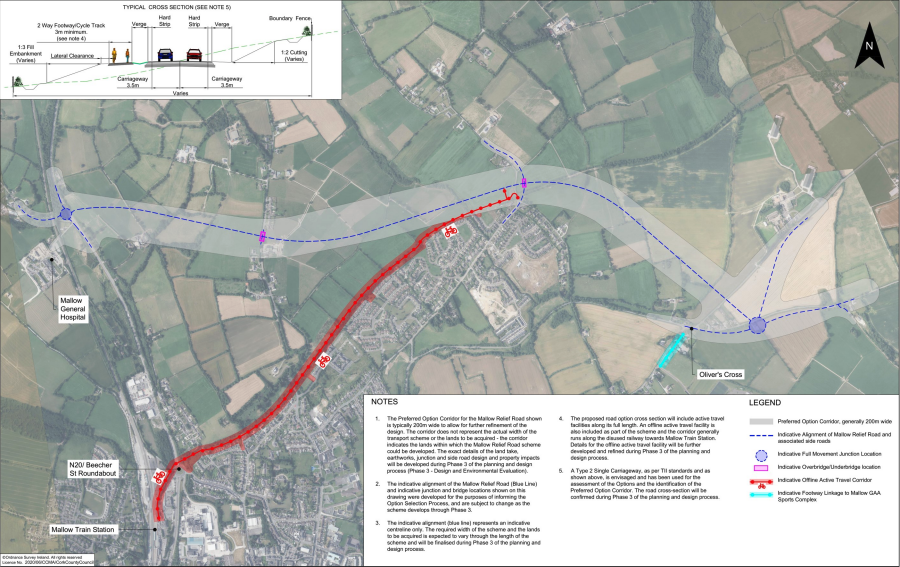
The proposed N72/N73 Mallow Northern Distributor Road represents one of the most significant transport investments planned for North Cork in recent decades. Developed by Cork County Council in partnership with Transport Infrastructure Ireland (TII), the scheme seeks to alleviate congestion within Mallow by providing a new east-west route connecting the N20 with the N72 and N73, while also improving conditions for pedestrians, cyclists and public transport users.
Beyond reducing journey times, the project should be understood within a broader strategic context. It aligns with Ireland's National Planning Framework, which seeks to strengthen regional centres outside Dublin through targeted investment in transport infrastructure. Better connectivity can support housing delivery, attract inward investment, improve freight efficiency and contribute to balanced regional development.
This article examines why the Mallow Northern Distributor Road matters—not only for motorists, but for the wider economic future of North Cork.
Mallow's Strategic Importance
Few towns in Munster occupy such an important position within Ireland's transport network as Mallow.
Located approximately 35 kilometres north of Cork City, Mallow functions as a gateway between Cork, Limerick, Kerry and the Midlands. It lies at the intersection of the N20, linking Cork and Limerick, the N72, connecting east-west traffic between Dungarvan and Killarney, and the N73, providing access to Mitchelstown and the M8 motorway.
In addition to its road network, Mallow is one of Ireland's busiest regional railway stations, serving intercity and commuter services. This combination of road and rail connectivity has enabled the town to develop as an important commercial, agricultural and service centre for North Cork.
The town's success, however, has created increasing pressure on infrastructure that was designed for a much smaller population and lower traffic volumes.
Why Congestion Matters
Traffic congestion is often viewed as an inconvenience. Economically, however, it represents a measurable cost.
The Organisation for Economic Co-operation and Development (OECD) has repeatedly identified efficient transport systems as fundamental to national productivity because they reduce transaction costs, improve labour mobility and enhance market accessibility.
Transport economists frequently refer to "generalised travel costs", which include not only fuel consumption but also travel time, reliability and vehicle operating costs. Businesses place considerable value on predictable journey times because reliability influences delivery schedules, staff productivity and customer service.
Congestion therefore imposes costs that extend well beyond individual motorists.
For freight operators, delays increase operating costs through:
higher fuel consumption;
increased driver hours;
reduced fleet utilisation;
greater vehicle wear; and
disruption to supply chains.
For commuters, congestion reduces the effective size of labour markets by increasing travel times between homes and places of employment.
These relationships are well established within transport economics and form part of the appraisal methodology used by Transport Infrastructure Ireland when evaluating major infrastructure projects.
The Role of the Northern Distributor Road
The proposed scheme is intended to provide an alternative route around Mallow for east-west traffic travelling between the N20 and the N72/N73.
According to Cork County Council and TII, the objectives extend beyond increasing road capacity. The project aims to:
reduce congestion within the town centre;
divert heavy goods vehicles away from urban streets;
improve road safety;
facilitate walking and cycling infrastructure;
enhance environmental conditions within the town; and
improve accessibility for all transport users.
Importantly, the project reflects modern transport planning principles.
Road projects are no longer designed solely to maximise vehicle throughput. Instead, they seek to balance the needs of freight, public transport, pedestrians, cyclists and local communities.
Infrastructure and Economic Growth
The relationship between transport infrastructure and economic performance has been extensively studied.
Urban economist Professor Edward Glaeser has argued that improved transport connectivity increases productivity by expanding labour markets and facilitating agglomeration economies—the benefits that arise when businesses and workers locate closer together.
Similarly, economic geographer Sir Peter Hall observed that transport investment can fundamentally reshape regional economies by improving accessibility between firms, suppliers and consumers.
These theories are reflected in Irish planning policy.
The National Planning Framework (Project Ireland 2040) identifies improved regional connectivity as essential to supporting balanced growth outside Dublin. Investment in transport infrastructure is intended not only to reduce congestion but also to encourage sustainable economic development across regional towns.
For Mallow, this is particularly significant.
The town continues to experience residential growth while serving an extensive rural hinterland with strong agricultural and industrial sectors.
Freight Transport and Regional Competitiveness
North Cork remains one of Ireland's most productive agricultural regions.
Its economy depends upon efficient movement of:
agricultural produce;
animal feed;
fertiliser;
building materials;
manufactured goods;
machinery; and
consumer products.
Road freight therefore underpins much of the region's economic activity.
The presence of large numbers of heavy goods vehicles travelling through Mallow reflects the town's strategic importance rather than simply local demand.
By providing an alternative route for through traffic, the proposed distributor road has the potential to improve both freight efficiency and the urban environment.
Reducing interactions between long-distance HGV traffic and local movements may also improve safety for pedestrians and cyclists.
Supporting Housing Delivery
One of the less frequently discussed benefits of transport infrastructure concerns housing.
Residential development depends upon supporting infrastructure.
Without adequate road capacity, increasing housing supply can place additional pressure on already congested networks.
The National Planning Framework emphasises that transport and land-use planning should be integrated rather than considered independently.
In practical terms, improved transport infrastructure allows towns such as Mallow to accommodate population growth while maintaining accessibility for existing residents.
As North Cork continues to expand, investment in strategic transport infrastructure is likely to become increasingly important.
Environmental Considerations
Road construction inevitably raises environmental questions.
Modern infrastructure projects require extensive environmental assessment before planning approval can be granted.
For the Mallow scheme, Cork County Council is currently progressing the Environmental Impact Assessment Report (EIAR) alongside detailed engineering design as part of Phase 3 of the TII Project Management Guidelines.
Environmental assessment typically considers issues including:
biodiversity;
water quality;
landscape;
archaeology;
cultural heritage;
air quality;
noise;
climate impacts; and
ecological mitigation.
Balancing environmental protection with infrastructure provision has become one of the defining challenges of modern transport planning.
Progress to Date
Development of the Mallow Relief Road has followed the structured process required under the TII Project Management Guidelines.
Key milestones include:
2019 – Cork County Council appointed engineering consultants to develop the scheme.
2020 – Phase 1 (Concept and Feasibility) completed.
2020–2022 – Public consultation and option selection.
2022 – Preferred route corridor identified following appraisal.
Current Phase – Design development and environmental evaluation.
Recent updates indicate that the project team has been advancing the detailed design, Environmental Impact Assessment Report and business case with the intention of progressing to the statutory planning process, subject to the necessary approvals and funding.
While the timing of major infrastructure projects inevitably depends upon planning, funding and procurement processes, continued progression demonstrates the strategic importance attached to the scheme.
Looking Beyond Congestion
Perhaps the greatest mistake is to view the Northern Distributor Road simply as a bypass.
International research consistently demonstrates that transport infrastructure influences regional development through multiple channels.
Improved accessibility can:
encourage business investment;
strengthen regional labour markets;
improve logistics;
support housing delivery;
enhance tourism;
reduce transport costs; and
improve quality of life.
These benefits rarely occur immediately.
Instead, they accumulate over decades as businesses respond to improved accessibility and communities adapt to new patterns of development.
The economic legacy of major transport infrastructure is therefore measured not simply in reduced journey times, but in the opportunities it creates for future generations.
Conclusion
The proposed Mallow Northern Distributor Road represents far more than an engineering project.
It forms part of a broader national strategy to strengthen regional centres through targeted investment in transport infrastructure.
For Mallow, improved connectivity has the potential to enhance freight efficiency, improve road safety, support future housing development and reinforce the town's role as the commercial heart of North Cork.
Equally important, the project illustrates how modern infrastructure planning has evolved. Contemporary road schemes are expected not only to improve traffic flow but also to balance environmental protection, active travel, public transport and sustainable regional development.
As Ireland continues to pursue balanced economic growth under Project Ireland 2040, projects such as the Mallow Northern Distributor Road will play an important role in determining how regional towns evolve over the coming decades.
Further Reading
Cork County Council & Transport Infrastructure Ireland – N72/N73 Mallow Relief Road Project
Transport Infrastructure Ireland – Project Management Guidelines
Project Ireland 2040: National Planning Framework
National Development Plan 2021–2030
OECD, The Impact of Transport Infrastructure on Productivity and Regional Development
ESRI publications on regional development, transport and housing
Glaeser, E. Triumph of the City
Hall, P. Cities in Civilization